Views: 77587 Author: Site Editor Publish Time: 2025-01-06 Origin: Site
1. Overview of Austenitic Steel: Definition and Typical Applications
Austenitic steel retains a stable austenitic microstructure after normalizing (solution treatment). Alloying elements such as Ni, Mn, N, and Cr stabilize the austenite phase at room temperature.
Figure a): Pearlite and network cementite in hypereutectoid steel.
Figure b): Single-phase austenite microstructure with annealing twins.
Typical grades: 1Cr18Ni9, 1Cr18Ni9Ti
Typical applications: Chemical water treatment equipment and steam sampling tubes in thermal power plants
Key properties:
Good oxidation and acid corrosion resistance
Long-term service at 540–875°C
Limitation: Susceptible to intergranular corrosion, leading to brittle failure
2. Crystal Structure and Its Impact on Physical Properties
Austenite has a face-centered cubic (FCC) closest-packed structure with high atomic packing density. As a result, its specific volume (density) is lower than that of ferrite and martensite.
Volume effects:
Heating to the austenite region → volume contraction
Cooling transforms to ferrite‑pearlite → volume expansion
→ Internal stresses and distortion
Slip systems and formability:
Multiple slip systems → good plasticity and low yield strength
Ingots and billets heated to >1100°C before rolling/forging
Magnetic behavior:
Generally paramagnetic → can be used as non‑magnetic steel
Exception: Certain Fe‑Ni soft magnetic alloys have an austenitic structure but exhibit ferromagnetism
3. Thermal Conductivity and Linear Expansion: Processing Considerations
Austenite has poor thermal conductivity and a high coefficient of linear expansion, approximately twice the average of ferrite and cementite.
Phase Thermal Conductivity (arbitrary units) Ferrite 77.1 Pearlite 51.9 Martensite 29.3 Austenite 14.6 Cementite 4.2
Engineering conclusions:
Lowest thermal conductivity among steel phases (after cementite)
High‑alloy austenitic steels are even worse
Heavy sections must be heated/cooled slowly to reduce thermal stress and avoid cracking
Advantage:
High linear expansion coefficient → suitable for thermally sensitive instrumentation components
4. Austenite Formation and Phase Transformation Kinetics
4.1 Eutectoid Reaction
In eutectoid steels:
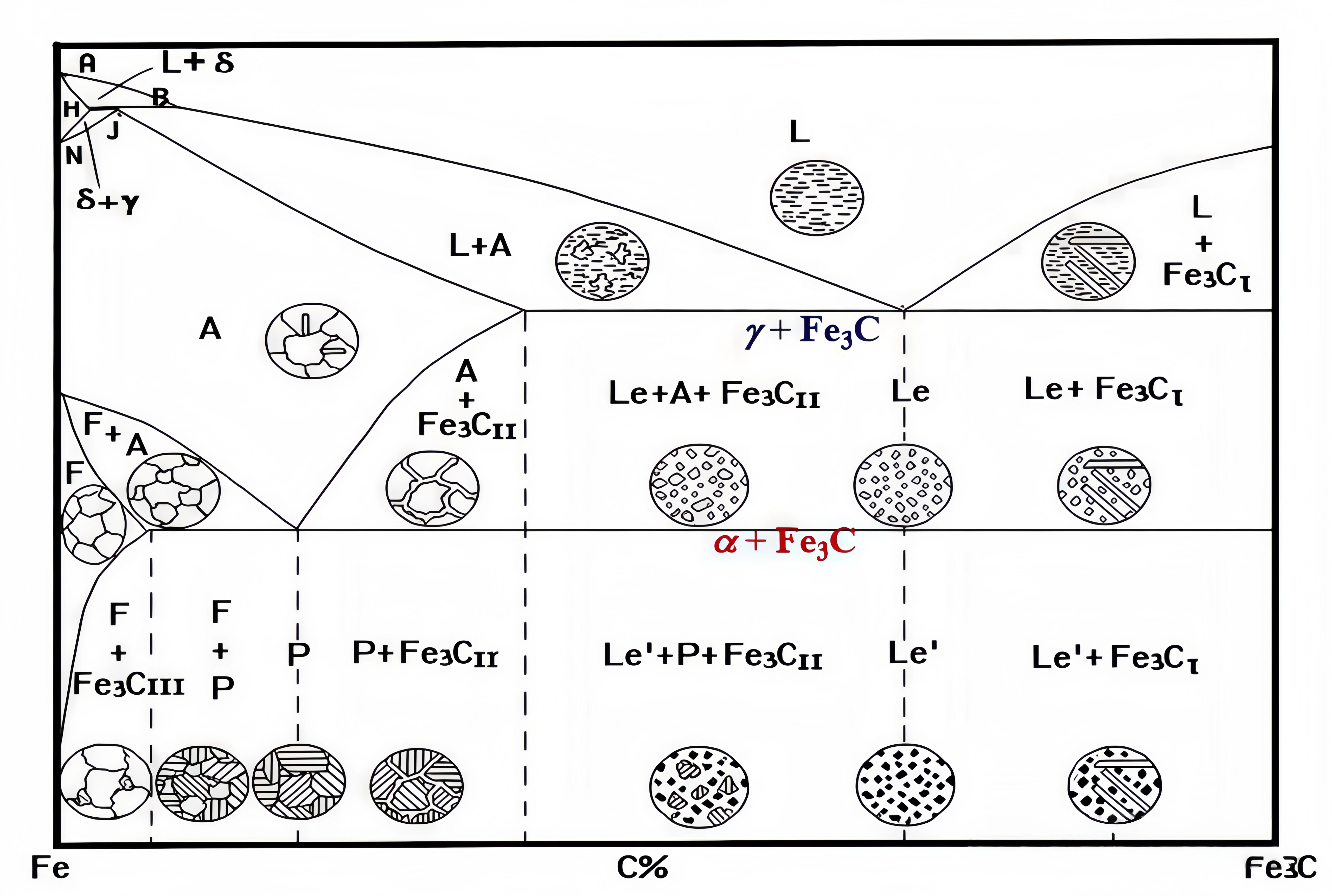
Cooling (below A₁): A → F + Fe₃C
Heating (reverse reaction): F + Fe₃C → A
Iron-carbon phase diagram: Pearlite (P), Ledeburite (Ld), transformed Ledeburite (Le), and Fe3C cementite types, for austenitic stainless steel and diaphragm compressor membrane analysis
Austenitization is a high-temperature diffusion-controlled transformation consisting of four stages:
Nucleation of austenite
Growth of austenite nuclei
Dissolution of residual carbides
Composition homogenization
Differences among steels: Hypoeutectoid, hypereutectoid, and alloy steels also involve dissolution of proeutectoid phases and alloy carbides.
4.2 Thermodynamic Condition
A supercooling or superheating ΔT is required.
4.3 Nucleation Sites and Mechanism
Nucleation is heterogeneous and preferentially occurs at:
Ferrite/cementite interfaces
Pearlite colony boundaries
Ferrite subgrain boundaries
Reasons:
Large carbon concentration gradient (F: <0.02% C; Fe₃C: 6.67% C)
Carbon absorption and rapid interfacial diffusion
Satisfies energy, structural, and concentration fluctuation requirements
4.4 Nucleus Growth and Homogenization
At high temperatures, carbon diffuses rapidly; Fe and substitutional atoms also diffuse (interfacial + volume diffusion)
After ferrite disappears, residual cementite continues dissolving
After complete cementite dissolution, soaking is still required to achieve uniform carbon concentration
5. Factors Affecting Austenite Formation Kinetics
Heating temperature: Higher T → faster diffusion → faster austenitization
Heating rate: Faster rate → shorter incubation, higher transformation start/finish temperatures, shorter cycle time
Alloying elements:
Accelerate: Co, Ni
Retard: Cr, Mo, V
Minor effect: Si, Al, Mn
Alloying elements diffuse slower than carbon → require higher T and longer soaking
Initial microstructure:
Lamellar cementite (fine spacing) → faster formation
Spheroidized pearlite (annealed) → slowest formation
6. Control of Austenite Grain Growth
Influencing Factor Effect Higher T / longer time Coarser grains Faster heating Higher superheating → nucleation rate increases more than growth rate → grain refinement Carbon content
(within a certain range ↑)Increased growth tendency (beyond a certain level, Fe₃CⅡ hinders growth) Ti, V, Nb, Zr, Al Form dispersed carbides/oxides/nitrides → hinder grain growth → inherently fine‑grained steel Mn, P Promote growth Si, Ni Little effect Finer initial microstructure /
higher carbide dispersionFiner austenite grains
Practical application: Rapid heating + short soaking → ultra‑fine grains
7. Engineering Conclusions and Material Selection Guidelines
Austenitic steel offers excellent plasticity, non‑magnetic behavior, high‑temperature oxidation resistance, and acid corrosion resistance
Suitable for thermally sensitive components, power plant equipment, and critical parts such as compressor diaphragms
Limitations and cautions:
Intergranular corrosion risk
Poor thermal conductivity → slow heat treatment for thick sections
Volume effect → control distortion and internal stress
Austenitizing efficiency and grain size can be optimized by controlling heating temperature, heating rate, and alloy composition
8. Lontrex Engineering Practice: High-Performance Diaphragm Compressor Membranes
Based on the scientific principles and engineering characteristics of austenitic steel described above, Lontrex applies this knowledge to the manufacturing of diaphragm compressor membranes (diaphragm plates).
Material selection: High-quality austenitic stainless steel (such as 1Cr18Ni9Ti) ensures excellent corrosion resistance and high-temperature stability
Process control:
Strict adherence to austenitizing thermal cycles with precise control of heating temperature and cooling rate
Optimized heat treatment for thin-walled diaphragm structures to minimize thermal stress and distortion
Performance advantages:
High plasticity of austenite meets the cyclic deformation requirements of compressor diaphragms
Paramagnetic nature of austenite allows use in non-magnetic or low-magnetic applications
Grain refinement control enhances fatigue life of the diaphragm
Lontrex is committed to combining materials science with engineering manufacturing to provide customers with reliable, high-performance diaphragm compressor membrane solutions.